US Tech Giants Face Escalating Undersea Cable Threats from China's Gray Zone Tactics
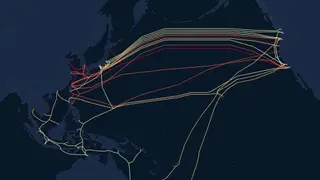
A new report identifies US-owned trans-Pacific undersea cables, particularly those of Google and Meta, as high-risk targets due to increased Chinese maritime activity near critical infrastructure. The analysis links China’s research vessel deployments and suspected cable-cutting incidents to strategic gray zone operations. These vulnerabilities threaten global internet stability amid rising geopolitical tensions.
In September 2026, a report by the China Strategic Risks Institute—commissioned by the US-China Economic and Security Review Commission—identified Google’s TPU project, Meta’s ORCA cable, and Verizon’s E2A cable as among the top five most vulnerable trans-Pacific undersea cables due to heightened Chinese maritime activity. These cables, critical for data flows between the U.S. and Asia, traverse shallow waters near Taiwan, Japan, and the Philippines—regions where China asserts territorial claims and has increased military and naval presence. The report introduced a Gray Zone Vulnerability Index that ranked risks based on cable depth, proximity to shipping lanes, ownership by U.S. firms, and geographic location relative to China’s exclusive economic zone and Taiwan. Notably, Chinese research vessels such as the Ke Xue were observed conducting prolonged survey-like movements near undersea infrastructure, including the Russian-owned Polar Express cable in the Bering Sea, raising concerns about dual-use capabilities. These findings build on earlier CSIS analysis (October 2026) showing that Chinese research ships spent disproportionately more time near subsea cables than their U.S. or Russian counterparts, even when not targeting mineral-rich zones. The underlying concern is that such activity could precede or mask sabotage operations—part of China’s broader gray zone tactics designed to destabilize infrastructure without triggering direct military conflict.
The stakes are high:
The vulnerability of undersea cables to state-backed gray zone operations could significantly disrupt digital infrastructure across the Indo-Pacific and beyond, affecting global financial systems, cloud computing services, and real-time communications. Given that a single major cable failure can force data rerouting through less efficient paths, even temporary disruptions may lead to measurable economic losses—especially in high-frequency trading and international business operations. The reliance on a few key trans-Pacific routes makes the system particularly fragile; if multiple cables were compromised during a geopolitical crisis, such as one involving Taiwan, the resulting congestion could ripple across global networks, impacting everything from video conferencing to supply chain logistics. This scenario bears resemblance to the 2013 incident when a ship’s anchor severed several cables in the Mediterranean, causing widespread internet outages—though that was accidental rather than